
A Cosmetic Dentist in Herndon Who Makes Results Look Natural
You know that thing you've been half-hiding for years? The chipped corner you cover when you laugh, the gap you've learned to smile around, the color that brushing just doesn't touch. Most people who come to us for cosmetic work have one or two things like that, not a long list. They're not looking for a dramatic change. They want something fixed so it looks like it was never broken. Dr. Ahmad has been doing this kind of careful, specific work for over 15 years, and her approach is the same every time: start with what you actually need, match it to what's already there, and never push anything you don't. When you're ready to talk through what's been bothering you, we'll listen first.
Request an appointment when you're ready. We'll verify your benefits before you come in and go over what to expect. No pressure, no surprises. Call us at (703) 793-0076 or request online. Open Saturdays. Se Habla Español.
What Cosmetic Dentistry Actually Covers and What to Ask Before You Start
Think of cosmetic dentistry less as a specific set of procedures and more as an intention. Any dental work done primarily to improve how your teeth look falls into this category. That can be as small as smoothing a rough edge in a single appointment, or as involved as a coordinated plan that addresses color, shape, and spacing across several visits. Where you fall on that range depends entirely on what you want to change.
Worth knowing before you start: cosmetic and restorative work overlap more than most people expect. A tooth that's chipped and also structurally compromised, for example, may need a crown regardless of appearance. When it does, that crown can be made to look exactly right, and your insurance may cover a meaningful portion of the cost because the clinical need is there. We watch for this at every exam, because it's one of the ways we can help cosmetic treatment cost less than patients expect. Our approach at Tooth Doc is always to address what the tooth needs first and let the cosmetic result follow from that, not the other way around. You can find a helpful overview of cosmetic dental work from the American Dental Association's MouthHealthy resource.
A cosmetic consultation is also the right time to say what you don't want. If you're worried something will look too white, too uniform, or too obviously worked on, say so. The best cosmetic results are built to match you: your other teeth, your face, your age, not a template. You can learn more about our full service dental office by visiting Tooth Doc Family Dentistry.
Porcelain Veneers Cover a Lot of Ground in One Visit
Here's what makes porcelain veneers work well for some patients and not for others. They're a strong choice when a tooth needs significant correction: deep staining that doesn't respond to whitening, a chip that's more than minor, or a shape that's noticeably off relative to the surrounding teeth. Each veneer is custom-made in a lab, shade-matched to your existing teeth, and fabricated with the same kind of layered translucency that natural enamel has. That last part is why a well-placed veneer is difficult to spot up close. The process takes two appointments and does involve removing a small amount of enamel from the front of the tooth, which is permanent, so it's worth talking through carefully. If you've been wondering whether veneers are the right call for what you want to fix, the cosmetic dental exam is where we sort that out. Come in and ask about porcelain veneers and we'll give you a straight answer.
Dental Bonding Can Fix a Chip, a Gap, or a Stain Without Removing Tooth Structure
Dental bonding applies a tooth-colored composite resin directly to the tooth, where it's shaped and hardened in a single visit. It's one of the least invasive cosmetic procedures available. Because it typically requires little to no enamel removal, it doesn't change the underlying tooth. You're adding to it rather than altering it, which is why a lot of patients who want to preserve as much of their natural tooth as possible go this route first. It's a good fit for a chipped edge, a small gap between front teeth, or a spot of discoloration that stands out against an otherwise healthy tooth. Bonding isn't as stain-resistant as porcelain over the long run and usually needs to be refreshed or replaced after several years, but for the right situation it's a fast, affordable, and very effective fix. The Cleveland Clinic's guide to dental bonding is a good plain-language reference if you want to read more before your visit. Our team can help you figure out whether dental bonding fits what you have in mind.
Composite Bonding Is Often the Gentlest Route to a Noticeably Better Tooth
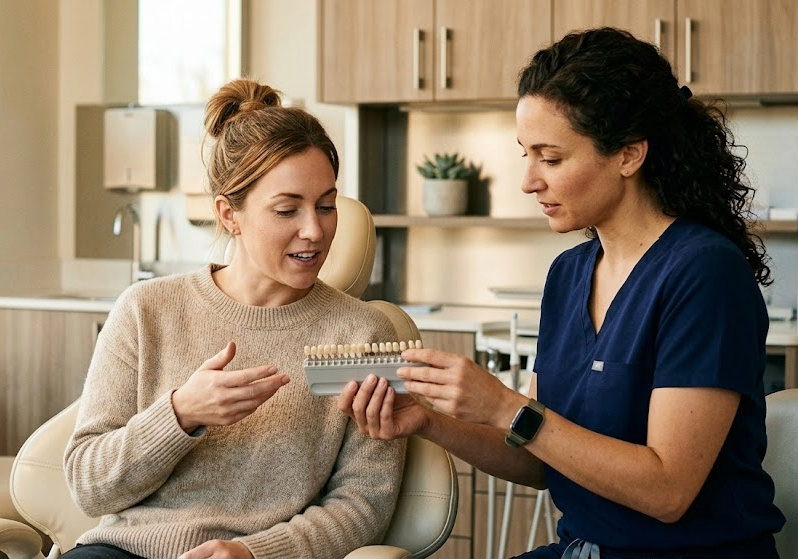
Patients sometimes mix up composite bonding and dental bonding, and the materials are the same, so the confusion is fair. The difference is scope. Dental bonding typically fixes one tooth in one visit. Composite bonding takes that same process and applies it across several teeth at once, which makes it the right tool when the concern isn't one chipped corner but a broader pattern: uneven lengths across the front teeth, gaps in more than one place, color that varies noticeably from tooth to tooth. The resin gets applied directly, shaped by hand, and cured with a light right in the chair. No impressions, no lab, no second appointment. It won't outlast porcelain and it picks up staining faster, which is worth knowing going in. But it costs less upfront, nothing about the natural tooth has to be permanently altered, and if you want to change something later, you can. Worth asking about if you've been sitting on this kind of thing for a while. Ask us about composite bonding options during your exam
Not sure which cosmetic treatment fits your situation? A quick consultation is the easiest way to sort it out. Call (703) 793-0076 or request an appointment online. We're open Saturdays and file insurance on your behalf.
A Smile Makeover Is Really a Coordinated Plan, Not One Giant Procedure
The term "smile makeover" can sound bigger than it is. In practice it just means a treatment plan that combines more than one cosmetic service to address a set of related concerns together. Someone who wants to correct both color and shape on their front teeth, for example, might need bonding on one tooth and a veneer on another. We map that out in a single consultation and sequence the work in a way that makes sense for your teeth and your schedule. Dr. Ahmad takes a conservative approach: we start with the smallest change that gets you the result you're after. You can read more about how we build a smile makeover plan during your first visit.
Tooth Contouring Is One of the Simplest Changes We Make, With a Surprisingly Clear Result
Dr. Ahmad's patients sometimes come in with a very specific complaint. Not "I want whiter teeth" or "I want a whole new smile" but something like: "this one tooth is a tiny bit longer than the one next to it and it drives me crazy." That's exactly what contouring is for. By removing a small amount of enamel from a specific edge or tip, the shape of the tooth changes. Sometimes that's all it takes. No crown, no veneer, no impression sent to a lab. Most of the time it's done in a single visit without anesthetic because the amounts removed are so small. It's often used alongside bonding, where one tooth gets a little trimmed and a neighboring one gets a little added, so the whole front group looks like it belongs together. Bring a photo if you have one of what you've been noticing. That usually makes the conversation much faster. Ask about tooth contouring at your next visit.
Start With a Cosmetic Dental Exam at Our Herndon Office and We'll Map Out Your Options
A cosmetic dental exam is shorter and more specific than a full checkup. We look at what you want to change, assess what the teeth need to support that change, and walk you through the options that make sense for your situation, including cost and what insurance, if any, might apply. There's no obligation to move forward with anything that day. For most patients, this single conversation makes everything much clearer: what's involved, what it will look like, what it costs, and how long it takes. Schedule your cosmetic dental exam at our Herndon office when you're ready and we'll take it from there.
Frequently Asked Questions About Cosmetic Dentistry at Tooth Doc
Does insurance cover cosmetic dental work?
Usually not, but the honest answer is more complicated than that. Most plans treat cosmetic procedures as elective, so veneers, bonding done purely for appearance, and similar work generally aren't covered. Where it gets interesting is the overlap between cosmetic and restorative work. A tooth that needs a crown for structural reasons can receive a porcelain crown that looks completely natural, and the insurance coverage follows the clinical need, not the cosmetic outcome. Delta Dental has a clear explainer on how insurance distinguishes cosmetic from restorative procedures if you want to understand the general rules before your visit. We go through your benefits before any treatment begins, so you know what your plan covers and what it doesn't before you agree to anything. CareCredit financing is available for anything that falls outside coverage, and we're happy to talk through costs up front so there aren't any surprises.
How do I know which cosmetic procedure is right for me?
Patients ask this a lot, and the truthful answer is that we can't tell you until we see your teeth in person. What looks like a simple bonding case from a description sometimes turns out to need a veneer once we get a close look at the amount of tooth structure that's affected. The reverse happens too. Someone who comes in expecting veneers leaves with a plan for bonding that costs a third of the price and gets the same result. What we can say in general: bonding and composite bonding make sense for corrections that are relatively minor and for patients who want something reversible. Veneers make sense when the issue is more significant and a longer-lasting solution is worth the higher investment. Contouring is its own category entirely. It removes material rather than adding it, and for the right problem it's the simplest fix of all. Book a cosmetic dental exam and we'll look at the actual teeth and tell you what we'd recommend.
Will cosmetic work look natural, or will people be able to tell?
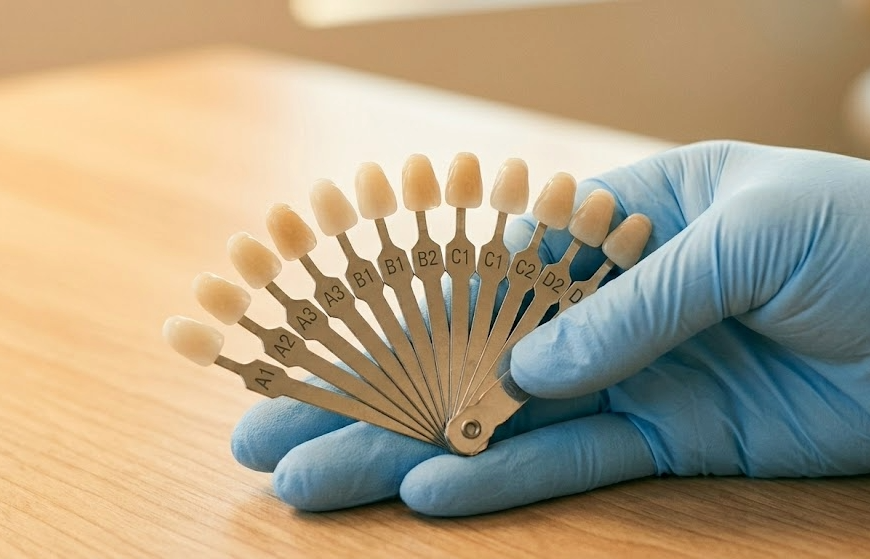
This is probably the question we hear most often, and it's a reasonable one given how much obviously worked-on dental work is out there. Two things tend to make cosmetic results look off: shade-matching that goes too white or too uniform, and a shape that doesn't fit the proportions of the person's face. Neither of those is a material problem. Porcelain veneers fabricated well and placed by someone who knows how to match them are genuinely difficult to distinguish from natural teeth. Composite bonding done carefully reads the same way. What you're seeing when dental work looks fake is usually a shortcut on the artistic side of the work, not a limitation of what the materials can do. Our job is to match what's already in your mouth, not replace your smile with something off a display chart.
Can I get cosmetic work done here if I also need restorative treatment?
Almost always yes, and frequently the two get handled in the same sequence of appointments. Patients sometimes worry that having a cavity or a cracked tooth disqualifies them from cosmetic work, but really it just means we address the clinical issue first and build the cosmetic outcome on top of a healthy foundation. A tooth getting a crown because it cracked gets a porcelain crown that matches the surrounding teeth. A tooth with a cavity that also has a chip gets restored so both problems are solved at once. If something has to happen in a specific order before we can move to the cosmetic part, we'll explain exactly what and why. Nothing gets done without you knowing what's coming next.
Our Team
-
Imaney N. Ahmad DMD
Dentist
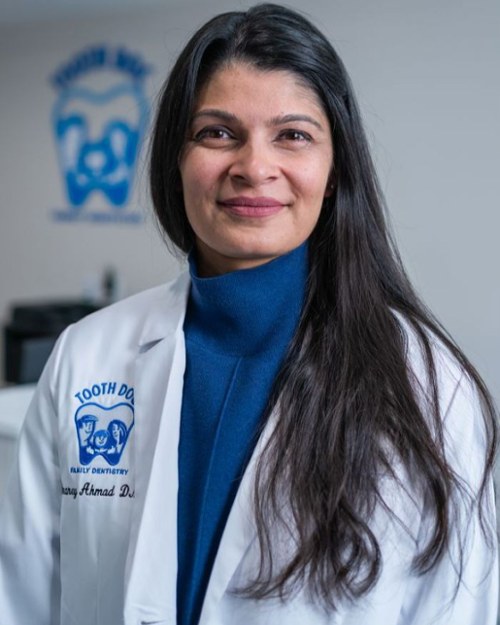
ViewDr. Ahmad proudly serves patients in the Herndon, VA community, including Reston and Sterling. Originally from New York and Central Florida, she earned her Doctorate in Dental Medicine from Temple University’s Kornberg School of Dentistry in 2010.
During her time in Philadelphia, Dr. Ahmad gained extensive clinical experience treating one of the nation’s largest dental school patient populations, with a special focus on serving underserved and uninsured communities in North Philadelphia. That experience helped shape her deep commitment to community care and access to quality dentistry.
Dr. Ahmad is a …